Shame is often missed in the treatment of trauma, depression, anxiety, and many other problems you see every day. It presents in paralyzing ways for clients like somatic pain, discomfort, emotion dysregulation, strong emotions, numbness, or other distress. This course teaches you how to get to and treat deeply embedded aspects of suffering that can truly free your clients. You'll learn skills and techniques to help your clients rebuild their self-esteem, challenge negative voices, feel confident in who they are, and so much more. PLUS, you're getting training in the most effective and in-demand modalities like mindfulness, EMDR, body-based and somatic, psychodynamic, cognitive behavioral therapy, and more. This new depth of knowledge will help you to better serve your clients, especially those struggling the most.

Free Course! | Janina Fisher’s Shame Certification Training
Get FREE Access to Our Best-Selling Course
This is a limited time offer!
"You'll never be good enough."
Shame lurks in memories, childhood traumas, and daydreams. It's the voice in their heads telling them they're flawed, broken, and fundamentally unworthy of love…
And no matter what you treat, shame is present in your clients. In fact, it's one of the hardest to work with issues standing in the way of their healing…
That's why I'm so excited to share my Shame Certification Training with you ABSOLUTELY FREE.
In simple-to-follow video trainings, I'll show you how to help clients resolve their living legacies of shame and shut down the critical voices — so they can reconnect with their minds, bodies, emotions, and most genuine self.
I'll guide you every step of the way and give you the integrated framework of techniques from somatic therapy, parts work, EMDR, CBT, and other top approaches that I've used to help countless clients.
This program is the culmination of over 40 years of research and clinical experience that has made me one of the most trusted clinical voices on shame today.
This program is the culmination of over 40 years of research and clinical experience that has made me one of the most trusted clinical voices on shame today.
When you hit the register button, you'll get 30 days of access at no cost…
…and if you want to earn 17.5 Credit hours, get certified through Evergreen Certifications*, and get unlimited access to the recordings, you can upgrade for just £45,99.
Sign up now!
*Professional standards apply. Learn more at fr,evgcerts,com/csts
Janina Fisher's Shame Certification Training
Integrative Somatic, Sensorimotor, Mindfulness, &Neurobiological Strategies to Transform Self-Loathing
€781,96 Value
Free for 30 days!
Earn up to 17.5 Credit Hours and qualify to become a Certified Shame-Informed Treatment Specialist (CSTS) with the optional credit upgrade.
(Professional standards apply)
(Professional standards apply)
Presented in EN, subtitles in EN, ES, DE, IT, and FR, handouts in EN, ES, DE, FR, and IT
Why get certified in Shame with Janina?
Shame often presents in our clients as tension, discomfort, somatic symptoms, strong emotions, anxiety, depression, PTSD, suicidal ideation, and more. It can be easily overlooked and go unattended to by therapists. But, the truth is that when shame infiltrates the bodies, brains, and nervous systems of our clients — it leaves deeply embedded wounds. Wounds that talk therapy can't always get to. That's why in this unique certification course, Janina has created an integrated framework to target every facet of shame. Using innovative techniques from mindfulness, EMDR, body-based psychodynamic, and cognitive behavioral therapies, you'll be able to get to the root of whatever is causing your clients' pain.
Janina's training program goes beyond theoretical knowledge. You'll engage in, experiential exercises, case studies, in-session demonstrations, and interactive discussion forums with peers, allowing you to integrate the concepts and techniques directly into your clinical work. Walk away with practical tools and strategies that you can implement immediately.
Information about Janina Fisher
Shame often presents in our clients as tension, discomfort, somatic symptoms, strong emotions, anxiety, depression, PTSD, suicidal ideation, and more. It can be easily overlooked and go unattended to by therapists. But, the truth is that when shame infiltrates the bodies, brains, and nervous systems of our clients — it leaves deeply embedded wounds. Wounds that talk therapy can't always get to. That's why in this unique certification course, Janina has created an integrated framework to target every facet of shame. Using innovative techniques from mindfulness, EMDR, body-based psychodynamic, and cognitive behavioral therapies, you'll be able to get to the root of whatever is causing your clients' pain.
Janina's training program goes beyond theoretical knowledge. You'll engage in, experiential exercises, case studies, in-session demonstrations, and interactive discussion forums with peers, allowing you to integrate the concepts and techniques directly into your clinical work. Walk away with practical tools and strategies that you can implement immediately.
Information about Janina Fisher

Here's what your colleagues have said about Janina's Shame Course…
"Great to see footage of clinical sessions and her [Janina's] interspersed commentary, great structure for learning!" — Christine H., Psychotherapist
"I learned much that I can implement immediately in my practice." — Quencina G., Community Mental Health Counselor
"Great to see Janina in action to see the rapport with the client she had not met before…and to see Janina make a mistake, not beat herself up about it, learn from it, and despite this see the good in the session — great learning for me in multiple ways!" — Anne M., Counselor
"Excellent, compassionate, speaker with superb case examples and theoretical background." — George L., Psychologist
What You'll Discover Inside This Course
Janina will guide you through her revolutionary approach to shame treatment. Using engaging case studies, practical tools, and downloadable worksheets, she'll show you exactly what to say and do, every step of the way.
Shame, Self-Loathing and Trauma Treatment
Gain foundational insight into shame's "living legacy" in the body and mind. Understand how shame can block the access and healing of trauma wounds. Integrate body-based modalities to resolve shame and treat trauma. Janina will guide you in exploring:The Neurobiology of Shame & Attachment
The Meaning of Shame in the Treatment of Trauma
Treating Shame
- The role of shame in traumatic experience
- What to do with "treatment-resistant" shame
- Shame as an animal defense survival response
- Effects of shame on autonomic arousal
- Shame as a defense to traumatic attachment wounds
The Meaning of Shame in the Treatment of Trauma
- Shame as a survival strategy
- Trauma and procedural learning
- Implicit memory of disgust, degradation, and humiliation
- Shame-based meaning-making
- Cognitive schemas that exacerbate shame
- Vicious circle of shame and anger Internal Working Models
Treating Shame
- Why shame is hard to overcome
- Sensorimotor Psychotherapy: physiological state as the entry point for treatment
- Mindfulness-based techniques to combat trauma responses & inhibit self-judgment
- Regulate shame states with somatic interventions
- Unravel shame as implicit memory
- Work with shame-based cognitive schemas
Healing Shame with Acceptance and Compassion
- Dis-identifying with the shame
- Re-contextualize shame as a younger self or part
- Shame and the Structural Dissociation model
- Getting to know our "selves"
- Recognize the role of critical voices and judgmental parts
- Dual awareness of who we are now and who we were then bringing our adult compassion to our childhood vulnerability
Healing Shame in the Therapeutic Relationship
- How can we use therapy to 'repair' shame states?
- The role of therapeutic empathy
- Therapists as neurobiological regulators
- The social engagement system in trauma recovery
- Incorporate playfulness, acceptance, and curiosity
Healing Shame & Attachment Wounds
Gain a skillful understanding of how layers of shame and attachment wounds prevent our clients from achieving meaningful intimacy — then master interventions that help them move beyond these damaged attachment styles, fears, and deep alienation for good.Trauma & Alienation from One's Self
Brain Research: Somatic Remembering
- Manifestations of self-alienation
- Attunement, dysregulation, repair
- Effect of neglect and abuse on attachment formation
- Attachment styles & brain development
- Early body & emotional experience
Brain Research: Somatic Remembering
- Right vs. Left brain hemispheres
- Structural dissociation model
- Split-Brain research
- Case Study
Understanding How "Parts" Relate to Shame
- Learn the language of parts
- Know your clients' "Internal Community"
- Alienated parts experienced as feelings
- IFS for integration of structural dissociation
- Establish a relationship between the adult self & parts
- Increase capacity for social engagement
- Social engagement system of the therapist
- Video Demonstration
Janina Fisher's Shame Certification Training
Integrative Somatic, Sensorimotor, Mindfulness, &Neurobiological Strategies to Transform Self-Loathing
€781,96 Value
Free for 30 days!
Earn up to 17.5 Credit Hours and qualify to become a Certified Shame-Informed Treatment Specialist (CSTS) with the optional credit upgrade.
(Professional standards apply)
(Professional standards apply)
Presented in EN, subtitles in EN, ES, DE, IT, and FR, handouts in EN, ES, DE, FR, and IT
BONUS SESSION!
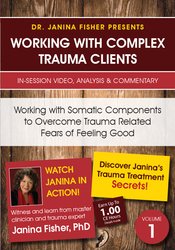
Real Client Session with Janina: Overcome Trauma-Related Fears of Feeling Good
Join Janina with "M," a 45-year-old woman who feels ready for a relationship but is paralyzed by shame and trauma, preventing her from connecting to and expressing positive feelings. Despite years of talk therapy, she has not been able to resolve childhood trauma and shame that deeply damages her ability to develop intimacy. Watch as Janina employs somatic techniques that help M to relax, let down her guardedness, and even see what happens when Janina accidentally triggers M. Gain confidence and see how reprocessing shame and trauma can truly free your clients!
Frequently Asked Questions
Shame is often missed in the treatment of trauma, depression, anxiety, and many other problems you see every day. It presents in paralyzing ways for clients like somatic pain, discomfort, emotion dysregulation, strong emotions, numbness, or other distress. This course teaches you how to get to and treat deeply embedded aspects of suffering that can truly free your clients. You'll learn skills and techniques to help your clients rebuild their self-esteem, challenge negative voices, feel confident in who they are, and so much more. PLUS, you're getting training in the most effective and in-demand modalities like mindfulness, EMDR, body-based and somatic, psychodynamic, cognitive behavioral therapy, and more. This new depth of knowledge will help you to better serve your clients, especially those struggling the most.
Knowing how to peel back shame and treat trauma is a clinical expertise that is highly sought-after by clients and employers alike. This certification shows your clients you care about providing the best care possible, enhancing your client's trust and building rapport before the first session even begins. Your certification serves as both a personal accomplishment and an unbiased professional barometer of your dedication to your practice. Finally, you're learning with none other than world-renown traumatologist and shame-resiliency expert, Janina Fisher!
Set yourself apart, increase opportunities for career advancement, increase client referrals, and more!
Immediately when you register, you'll have access to all course materials — video demonstrations, slides, handouts, and more!
100% Satisfaction Guarantee
Register for this intensive training course without risk. If you're not completely satisfied, Contact Us.We’re that confident you'll find this learning experience to be all that's promised and more than you expected.
Janina Fisher's Shame Certification Training
Integrative Somatic, Sensorimotor, Mindfulness, &Neurobiological Strategies to Transform Self-Loathing
€781,96 Value
Free for 30 days!
Earn up to 17.5 Credit Hours and qualify to become a Certified Shame-Informed Treatment Specialist (CSTS) with the optional credit upgrade.
(Professional standards apply)
(Professional standards apply)
Presented in EN, subtitles in EN, ES, DE, IT, and FR, handouts in EN, ES, DE, FR, and IT